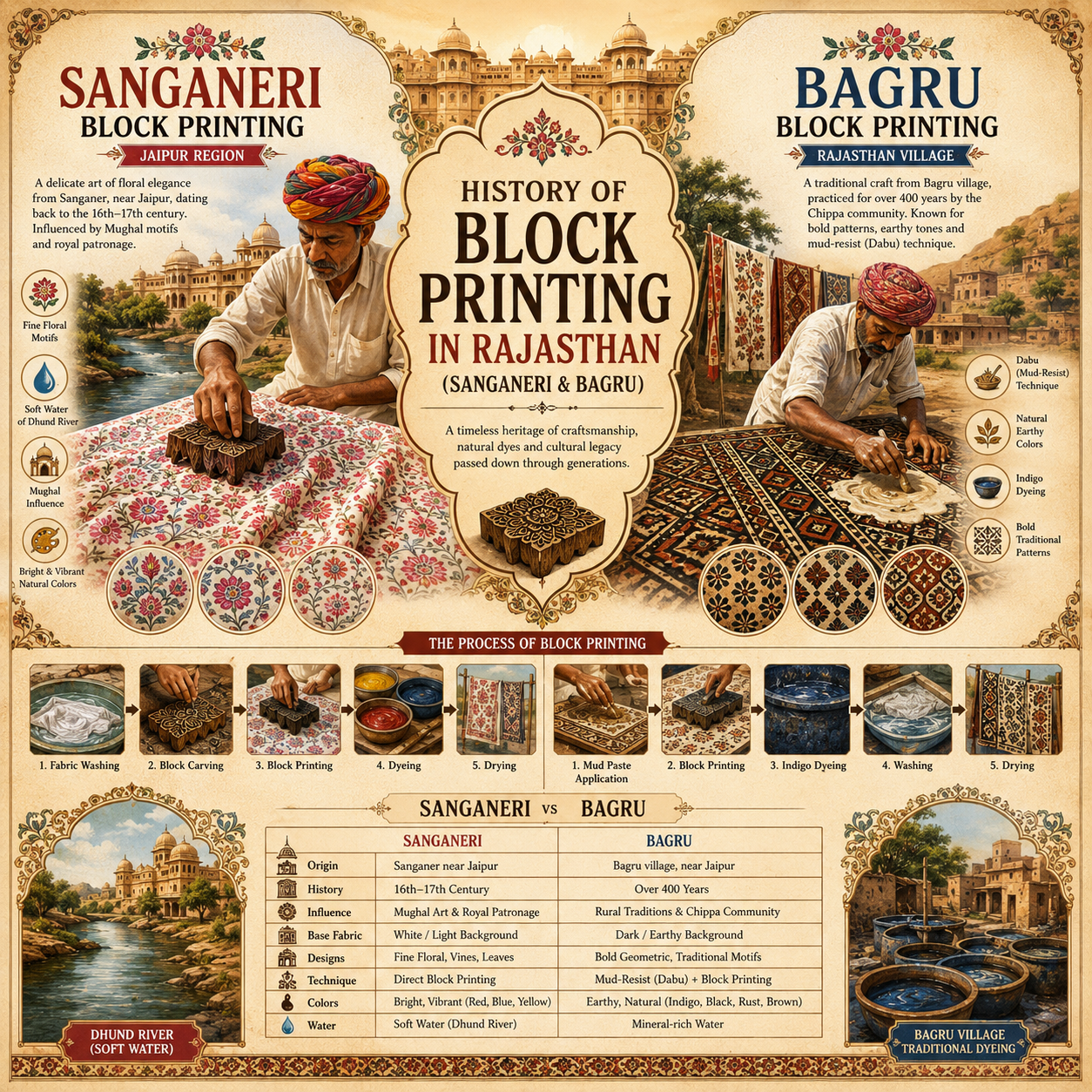
History of Block Printing in Rajasthan (Sanganeri & Bagru)
📍 Sanganeri Block Printing (Jaipur Region)


Sanganeri block printing originates from the town of Sanganer, located near Jaipur, and is known for its delicate floral designs, intricate detailing, and fine lines. This style is often associated with elegance and was historically preferred by royal families and elites.
The history of Sanganeri printing dates back to around the 16th–17th centuries, when skilled artisans migrated to Rajasthan from regions like Gujarat due to political disturbances and economic opportunities. These artisans brought with them advanced techniques of textile printing, which later evolved into the distinctive Sanganeri style.
A major reason for the development of this craft in Sanganer was the availability of clean water from the nearby Dhund River. The soft water was ideal for achieving bright and clear colors on fabric, especially on white backgrounds, which became a signature of Sanganeri prints.
Sanganeri block printing is primarily done on a white or light-colored base, using natural dyes such as indigo (blue), madder (red), and turmeric (yellow). The designs are typically floral, inspired by Mughal gardens, including motifs like roses, sunflowers, and vines. This influence can be traced back to the Mughal era, when art and culture flourished in India, and textile crafts received royal patronage.
The process involves several steps:
- Preparing the fabric (washing and bleaching)
- Creating wooden blocks with intricate carvings
- Dipping blocks in dye and stamping them onto fabric
- Drying and fixing the colors
Each block is hand-carved, often from teak wood, and requires high precision. The alignment of patterns demands skill and experience, making each piece unique.
Over time, Sanganeri prints gained popularity not only in India but also in international markets. Today, they are used in garments like sarees, suits, scarves, and home furnishings.
🎨 Bagru Block Printing (Traditional Mud-Resist Style)


Bagru block printing comes from the town of Bagru, located about 30 km from Jaipur. Unlike Sanganeri printing, Bagru prints are known for their earthy tones, bold patterns, and traditional appeal.
The origins of Bagru printing are linked to the Chippa community, a group of traditional printers who have practiced this craft for generations. The word “Chippa” comes from the Hindi word “chhapna,” meaning “to print.”
Bagru printing is believed to have started over 400 years ago and is deeply rooted in rural traditions. It uses natural dyes and a unique technique called Dabu printing, which involves mud-resist printing. In this process, certain parts of the fabric are covered with a mixture of mud, gum, and lime to resist dye penetration.
The typical colors used in Bagru prints include:
- Black (made from iron filings and jaggery)
- Red (from madder root)
- Blue (from indigo)
- Beige and brown tones (from natural earth elements)
The process of Bagru printing includes:
- Pre-treatment of fabric with water and natural substances
- Application of mordants to fix dyes
- Block printing with natural dyes
- Dabu (mud-resist) application
- Dyeing in indigo vats
- Washing and drying in sunlight
One distinctive feature of Bagru prints is the use of a darker base color, unlike the white base of Sanganeri prints. The designs are more geometric and bold, including motifs like leheriya waves, dots, and traditional symbols.
The water quality in Bagru also plays a crucial role. The slightly mineral-rich water contributes to the unique shades of colors, giving Bagru prints their characteristic rustic look.
⚖️ Difference Between Sanganeri & Bagru Printing
| Feature | Sanganeri Printing | Bagru Printing |
|---|---|---|
| Base Fabric | White / Light | Dark / Off-white |
| Design Style | Fine floral, delicate | Bold, geometric |
| Color Palette | Bright, vibrant | Earthy, natural |
| Technique | Direct block printing | Mud-resist (Dabu) |
| Influence | Mughal art | Rural traditions |
| Water Type | Soft water | Mineral-rich water |
🧶 Cultural & Economic Significance
Both Sanganeri and Bagru block printing are not just textile techniques but an important part of Rajasthan’s cultural identity. These crafts have been passed down through generations and continue to provide livelihood to thousands of artisans.
In recent years, there has been a renewed interest in sustainable and eco-friendly fashion, which has boosted the demand for natural dye-based textiles like Sanganeri and Bagru prints. Designers and brands are increasingly incorporating these traditional techniques into modern fashion.
Moreover, these crafts have received Geographical Indication (GI) tags, which help protect their authenticity and promote them globally.
🌍 Modern Relevance & Global Reach
Today, both Sanganeri and Bagru prints are widely exported and appreciated in international markets. They are used in:
- Fashion apparel (kurtas, dresses, sarees)
- Home décor (bed sheets, curtains)
- Accessories (scarves, bags)
Efforts are also being made by government bodies and NGOs to support artisans, provide training, and improve working conditions. Craft fairs, exhibitions, and online platforms have further helped in promoting these traditional arts.