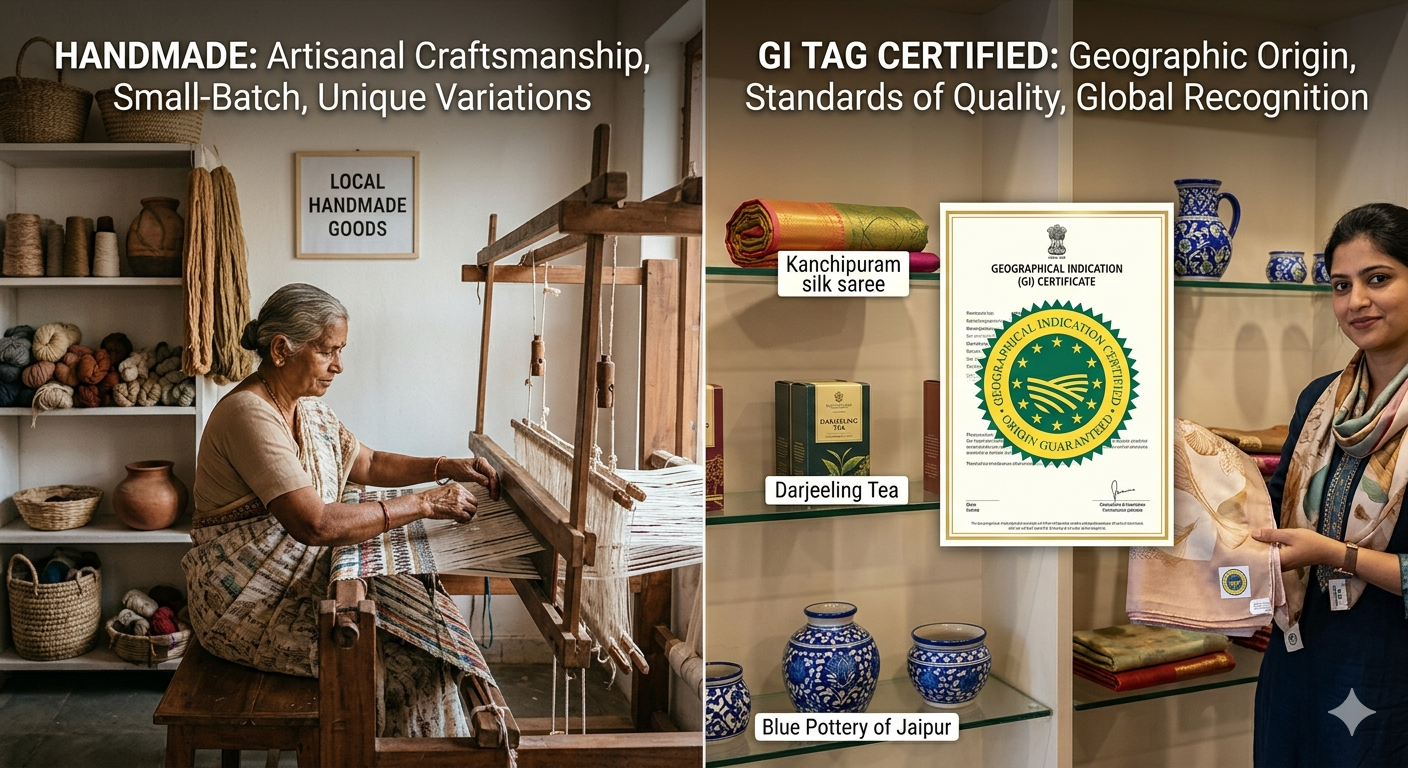
Difference Between Handmade vs GI Tag Certified Products
In today’s global marketplace, terms like “handmade” and “GI tag certified” are often used to highlight authenticity, quality, and cultural value. While both categories emphasize craftsmanship and tradition, they are not the same. Understanding the difference between handmade products and GI (Geographical Indication) tag certified products is important for consumers, artisans, and businesses alike. This distinction becomes especially relevant in a culturally rich country like India, where traditional crafts and regional specialties are deeply rooted in history.
What Are Handmade Products?


Handmade products are items that are created manually by artisans rather than being mass-produced using machines. These products reflect individual skill, creativity, and time investment. Handmade goods can include a wide range of items such as jewelry, clothing, pottery, home décor, paintings, and more.
The core feature of handmade products is that they involve human effort at every stage of production. Even if small tools or basic machinery are used, the primary process remains manual. For example, handwoven textiles, hand-painted ceramics, and carved wooden artifacts all fall under this category.
One of the biggest advantages of handmade products is uniqueness. No two handmade items are exactly identical, which gives them a special charm. Consumers often prefer handmade goods because they feel more personal and authentic. Moreover, buying handmade products directly supports local artisans and small-scale industries.
However, handmade does not necessarily mean the product is tied to a specific region or tradition. A handmade item can be produced anywhere in the world and may or may not have cultural or historical significance. This is where the distinction between handmade and GI-tagged products begins to emerge.
What Is a GI Tag Certified Product?


A GI (Geographical Indication) tag is a certification given to products that originate from a specific geographical location and possess qualities, reputation, or characteristics unique to that region. In India, GI tags are governed by the Geographical Indications of Goods (Registration and Protection) Act, 1999.
Examples of GI-tagged products include Darjeeling Tea, Banarasi Saree, Kanchipuram Silk Saree, and Mysore Sandalwood. These products are not just known for being handmade but are also associated with a particular place and tradition that has been preserved over generations.
A GI tag ensures that only authorized producers from the designated region can use the product name. This helps in protecting the authenticity of the product and prevents misuse or imitation by others. It also boosts the economic value of the product and helps preserve traditional knowledge.
Key Differences Between Handmade and GI Tag Certified Products
1. Definition and Scope
Handmade products are defined by the method of production—manual work done by artisans. GI-tagged products, on the other hand, are defined by their geographical origin and unique characteristics linked to that location.
2. Geographical Connection
Handmade items do not necessarily have a specific geographical identity. A handmade scarf, for instance, can be made anywhere. In contrast, a GI-tagged product like a Banarasi saree must come from a specific region (Varanasi) to be authentic.
3. Certification and Legal Protection
Handmade products generally do not require any formal certification unless they fall under specific quality or trade standards. GI-tagged products are legally protected under intellectual property laws. In India, the GI registry ensures that only genuine producers can use the product name.
4. Authenticity Assurance
While handmade products may be authentic in terms of craftsmanship, there is no standardized system to verify their origin. GI-tagged products come with a guarantee of authenticity linked to their geographical source.
5. Cultural and Historical Significance
Handmade products may or may not have cultural importance. GI-tagged products always carry cultural, historical, or traditional significance tied to their region of origin.
6. Market Value and Branding
GI-tagged products often have higher market value due to their recognized authenticity and reputation. Handmade products may vary widely in price depending on craftsmanship, materials, and brand positioning.
7. Production Scale
Handmade products can be produced individually or in small batches. GI-tagged products can also be handmade but are often produced by a community of artisans within a region following traditional methods.
Overlap Between Handmade and GI Products
It is important to note that many GI-tagged products are also handmade. For example, Banarasi sarees are handwoven, and Mysore sandalwood carvings are handcrafted. However, not all handmade products qualify for a GI tag because they may lack the geographical linkage and recognized uniqueness required for certification.
In simple terms:
- All GI-tagged handicrafts are handmade (in most cases)
- But not all handmade products are GI-tagged
Importance for Consumers
Understanding the difference helps consumers make informed choices. If someone is looking for a unique, artistic item, a handmade product may be sufficient. However, if they are interested in heritage, authenticity, and cultural value, a GI-tagged product is the better choice.
For example, buying a generic handmade saree is different from investing in a Banarasi saree with a GI tag. The latter guarantees tradition, origin, and craftsmanship that has been passed down for generations.
Importance for Artisans and Businesses
For artisans, GI certification can significantly enhance recognition and income. It protects their work from imitation and ensures fair competition. For businesses, GI tags provide branding opportunities and help build trust among consumers.
Handmade products, on the other hand, allow artisans more creative freedom. They are not bound by geographical or traditional constraints and can innovate according to market trends.
Challenges in Both Categories
Handmade products face challenges such as lack of standardization, limited scalability, and competition from machine-made goods. GI-tagged products face issues like enforcement of rights, counterfeit products, and lack of awareness among consumers.
Despite these challenges, both categories play a crucial role in preserving craftsmanship and supporting local economies.